



 August 13, 2026 11:22 am
Organizing a wine tasting at home is one of the best excuses to gather friends around a table. You don’t need to be a sommelier or have a cellar in the basement: just some good bottles, the right glasses, and a desire to learn to look, smell, and drink calmly. In this article, we tell you how to do a wine and brandy tasting at home following the professional ritual, what types of tastings you can prepare and what keys make the difference between a correct evening and a truly memorable one.
What is a wine tasting?
A wine tasting is the sensory analysis of a wine through three senses: sight, smell, and taste. Its purpose is to consciously appreciate its characteristics —color, aromas, flavor, body, balance— and better understand the story that each bottle holds: its grape variety, its aging, and its terroir.
There are professional tastings (rigorous, with technical sheets and often spitting) and informal tastings, made to enjoy with friends while learning along the way. This article focuses on the second —the one you can set up at home on a Saturday afternoon—, although the principles are the same as those applied by a winemaker or a sommelier.
What are the 3 phases of wine tasting?
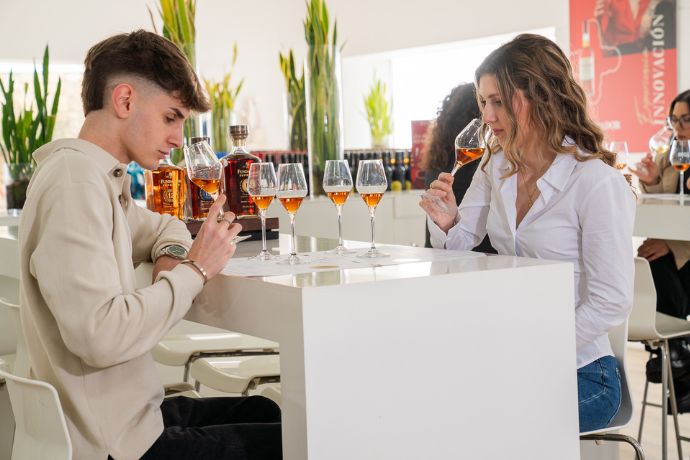
Every tasting —both of wine and brandy— is structured in three main phases, each associated with a sense. Doing them in order and with attention is what turns “drinking” into “tasting”.
1. Visual phase
The glass is tilted over a white tablecloth and the wine is observed against the light. We value color, tone, brightness, and clarity, in addition to the so-called tears (or legs) that the drops leave as they slide down the glass: if they are dense and slow, the wine usually has a higher degree or glycerin. In the brandy, this phase gains prominence: the golden, amber or mahogany tones speak directly of the type of cask in which it aged and the time spent in the solera.
2. Olfactory phase
It is done in two stages.
- First smell: with the glass still, you bring your nose close and inhale gently to perceive the primary aromas (fruit, flowers, herbs).
- Second smell: You swirl the glass to oxygenate the wine and awaken the secondary aromas (fermentation, yeasts) and tertiary (aging in wood, toasted, spices). In the brandy tasting, this phase is the richest: you can find nuts, vanilla, tobacco, cocoa and toasted caramel.
Brandy tasting tip from our experts: if you open your mouth while sniffing, the smell of the brandy will not be so harsh and it will be more pleasant.
3. Tasting phase
A small sip and passed around the entire mouth. We value sweetness, acidity, bitterness, body, balance and persistence (how long the flavor lasts after swallowing). In a Jerez brandy, long persistence is one of its hallmarks: the flavor can remain in the mouth for 30 seconds or more, evolving in different layers.
Types of tastings you can do at home
Choosing a specific type of tasting gives structure to the evening and helps the conversation revolve around a topic. These are the most common options:
- Classic or horizontal tasting. Several wines from the same vintage but from different wineries or areas are tasted. Perfect for comparing styles and discovering what you like the most.
- Vertical tasting. A vertical wine tasting brings together different vintages from the same winery and reference. It serves to understand how a wine evolves over time and is especially revealing with generous wines from Jerez, where aging has a central weight.
- Blind tasting. The wines (or brandies) are served with the bottles covered or previously poured into a decanter. It forces you to trust only your senses and is usually the most fun in an evening with friends. The blind tasting of Jerez brandy is ideal for discovering the differences between solera, solera reserve and solera gran reserve.
- Tasting with pairing. Each wine is accompanied by a specific tapa designed to enhance it. A classic Jerez example: Fino with Iberian ham, Amontillado with mushrooms, Oloroso with red meats and a good brandy with dark chocolate.
How to do a wine and brandy tasting at home?
With a little preparation, any living room can become a small tasting space. The important thing is to take care of the details: the selection of the bottles, the order of service and the support materials.
Essentials for organizing the tasting
- Appropriate glasses. Tulip-shaped fine glass for wines and tasting glasses ideal for tasting and tastings, which concentrate the aromas towards the nose. Ideally one glass per wine and a specific one for brandy.
- White tablecloth or napkins. Essential to properly appreciate the color in the visual phase.
- Corkscrew, decanter and ice bucket with ice (essential for serving Fino and Manzanilla at 7-9 ºC).
- Tasting cards or notebooks. A small form with the three phases and space for personal notes. You can print one or improvise with notebooks.
- Water and unsalted bread. To cleanse the palate between one glass and the next.
- Neutral tapas to accompany: nuts, olives, cured cheese, a little ham. Nothing too intense that masks the wine.
About the selection of wines: for a tasting at home, 3-5 bottles are enough. If you want to organize a monothematic tasting of Jerez, we recommend combining a Fino, an Amontillado and an Oloroso (or Palo Cortado) —three clearly different styles that teach you a lot in a small amount—. The Torre de Macharnudo (Harveys) range is an excellent option if you are looking for the maximum expression of the Marco. Close the evening with a glass of our sherry cask collection from Fundador, which served at 16-18 ºC prolongs the after-dinner conversation with the elegance of aging in a Jerez cask.
Tips to succeed with your friends
A memorable tasting is played as much in the wine as in the atmosphere. These are the details that make the difference:
- Natural lighting or white light. Avoid yellow or colored lights: they distort the tone of the wine. If it’s night, use neutral light lamps.
- Without air fresheners or scented candles. Foreign aromas are sworn enemies of the olfactory phase. Save the sprays and very fragrant flowers for another day.
- Background music, not protagonist. A jazz or flamenco in the background at low volume adds; a party playlist competes with the conversation and concentration.
- Serve from less to more intensity. Start with the lightest and freshest wines (Fino) and end with the most complex (Oloroso, Palo Cortado) and the brandy.
- Explain little, ask a lot. Tasting is a game of comparing impressions. Let each guest describe what they perceive before you say “what it is supposed to smell like”.
- Take care of the timing. Half an hour per wine is a good reference. Neither rush nor infinity: the rhythm is lost when the glass has been still for too long.
Frequently asked questions about wine and brandy tastings
How many wines are served at a tasting?
Between 3 and 5 references is ideal for a home tasting. More than 5 saturates the palate and makes the evening very long. The amount per guest is around 60-80 ml per glass, so with one bottle you have enough for 8-10 people.
How is a brandy tasting done?
Just like a wine one, but with two nuances: use a wine tasting glass (better than the tulip glass) to concentrate the aromas, and serve the brandy at 16-18 ºC —room temperature— never cold. Let the glass rest for 1-2 minutes before bringing it to your nose: the brandy needs to breathe.
Can a tasting experience be gifted?
Yes, and it is one of the most appreciated gastronomic gifts in recent years. Gifting a wine tasting in a Jerez winery —with a guided tour and paired menu— is a perfect way to surprise on birthdays, anniversaries or Christmas. The Fundador Gastro Experience includes both.
From your home tasting to our Fundador Wineries
A home tasting is a great starting point, but to truly understand the universe of Jerez wine and brandy there is only one way: to step into the winery. Feel the dimness, the silence of the boots, the constant temperature and the aroma of oak soaked with generations of aging.
At Fundador Wineries, the oldest winery in the Marco de Jerez, you can live two experiences designed to take your initiation to a new level:
- Visit to Fundador Wineries. A guided tour through the historic wineries founded in 1730, with an explanation of the criaderas and soleras system and tasting of our brandies and wines.
- Fundador Gastro Experience. Tuesdays and Thursdays at 2:00 p.m. It combines the guided tour of the wineries with a paired menu at the restaurant Casa Fundador, where each dish dialogues with a different glass. The most complete —and most delicious— way to discover the Jerez legacy.
Related Entries
This post was written by Almudena Alonso
Comments are closed here.